

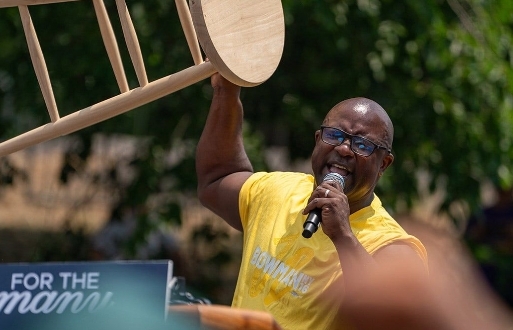
Outgoing Representative Jamaal Bowman, a Democrat from New York, shared a long and impassioned message on social media Tuesday, addressing “White people” in response to the recent acquittal of Daniel Penny, the former Marine who was involved in the death of Jordan Neely. Bowman’s post reflected his deep frustration with the legal outcome, which had drawn widespread public attention due to the controversial circumstances surrounding Neely’s death. The incident, which occurred earlier this year, involved Penny placing Neely, a homeless Black man, in a fatal chokehold on a New York City subway train.
Bowman’s statement conveyed a sense of disillusionment with the justice system, specifically regarding how it handled the case and the broader implications for race relations in America. In his post, he expressed anger and sorrow at what he perceived as a miscarriage of justice, contending that the acquittal of Penny signaled a systemic failure to protect Black lives. The death of Neely, who was reportedly suffering from a mental health crisis, had sparked protests and calls for greater accountability in how incidents involving police or civilians interacting with people of color are treated by the legal system.
The message was not only directed at the case itself but also at the larger context of racial inequality and the ongoing struggles faced by Black Americans. Bowman used the opportunity to underscore what he saw as a broader pattern of disregard for the lives and rights of Black individuals, particularly in situations involving law enforcement or public interactions. His call to “White people” reflected a plea for them to recognize their role in either challenging or perpetuating these systemic issues. Bowman suggested that inaction or silence in the face of injustice contributed to the perpetuation of racial disparities and inequality.
Many of Bowman’s supporters rallied behind him, praising his courage to speak out against what they viewed as an unjust ruling. However, his remarks also drew criticism from those who felt that his rhetoric was divisive or overly broad. Some commentators argued that targeting “White people” as a collective group was counterproductive and alienated potential allies who may be sympathetic to the cause of racial justice but felt unfairly generalized by such sweeping statements.
The acquittal of Daniel Penny had already been a point of contention in the media, with numerous debates taking place over whether Penny’s actions constituted self-defense or an excessive use of force. Penny had been charged with second-degree manslaughter and criminally negligent homicide after Neely’s death but was found not guilty by a jury, a verdict that many saw as a reflection of the racial dynamics that still influence the American justice system.
Bowman’s remarks were also seen as part of a larger national conversation about race, power, and the criminal justice system in the United States. For many, the incident highlighted the difficult questions about how society addresses the intersection of race, mental health, and public safety. Neely’s death, along with the trial and its outcome, brought attention to the challenges faced by homeless individuals, particularly those from marginalized communities, and the ways in which mental illness is often mishandled in public spaces.
In his message, Bowman called for greater accountability, urging both the legal system and society at large to reconsider how Black lives are valued and how systemic issues of racial injustice are addressed. He stressed that the fight for racial equality and justice was far from over and that it was essential for individuals, especially those in positions of privilege, to actively engage in the struggle to dismantle the structures that perpetuate inequality.
While Bowman’s statement sparked a range of reactions, it underscored the deep divisions in how Americans view issues of race, justice, and the legal system. His call for White people to reflect on their role in these systemic problems was a reminder of the ongoing work required to achieve true racial equity and the continued tension surrounding the pursuit of justice in a society that often seems divided on how to address these issues.
“Jamaal Bowman’s Message on Race and Justice: A Response to Daniel Penny’s Acquittal in the Death of Jordan Neely”


Recent Comments
on Hello world!