

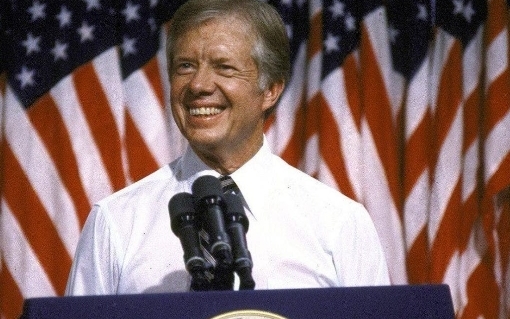
Jimmy Carter, the 39th president of the United States and a former peanut farmer, passed away at the age of 100 on Sunday at his home in Plains, Georgia. The Carter Center, which was founded by Carter to promote global health, peace, and human rights, confirmed his death. His life, filled with profound service to both the American people and humanity at large, left an indelible mark on both the domestic and international landscapes.
Carter’s journey to the White House was rooted in his background as a peanut farmer in the small town of Plains, Georgia. His humble origins and straightforward, no-nonsense approach to governance helped to shape his vision of what a “competent and compassionate” government could look like. His campaign for the presidency in 1976, built on promises of honesty, transparency, and ethical leadership, resonated deeply with a nation disillusioned by the Watergate scandal and the resignation of President Richard Nixon. Carter’s pledge to restore trust in government and bring a new sense of integrity to the Oval Office was one of the central reasons he won the election.
Upon assuming the presidency, Carter faced significant challenges both at home and abroad. Domestically, his administration focused on energy conservation, environmental protection, and expanding human rights. The United States was grappling with an energy crisis and soaring inflation, and Carter’s leadership style reflected his strong convictions about the need for bold action. In particular, he called for a nationwide commitment to energy conservation, urging Americans to reduce their consumption of oil and adopt alternative energy sources. Additionally, he signed important environmental legislation aimed at protecting the nation’s natural resources.
On the international stage, Carter sought to reposition the United States as a force for peace and diplomacy. His administration’s crowning achievement was the Camp David Accords in 1978, a historic agreement brokered by Carter between Egyptian President Anwar Sadat and Israeli Prime Minister Menachem Begin. The accords marked the first peace agreement between Israel and an Arab nation and were a monumental success for Carter’s foreign policy. Despite the successes, however, Carter’s presidency was also marked by setbacks, including the Iranian hostage crisis, which significantly damaged his public standing and contributed to his defeat in the 1980 election.
After leaving the White House, Carter’s post-presidency years became perhaps even more influential than his time in office. He spent decades traveling the world, working with the Carter Center to address issues such as global health, disease eradication, and promoting free and fair elections. One of his most notable achievements after his presidency was his role in the fight against diseases like Guinea worm disease. Through the Carter Center’s initiatives, he helped reduce the prevalence of this debilitating disease by more than 99 percent, saving countless lives and improving the health of entire communities. His efforts in global health earned him widespread admiration and respect, and in 2002, he was awarded the Nobel Peace Prize for his work.
In addition to his humanitarian efforts, Carter remained deeply involved in advocating for human rights and social justice. He consistently spoke out against racial inequality, violence, and injustices in the United States and around the world. His unwavering commitment to peace and human dignity earned him a place among the most revered statesmen of his era.
Throughout his life, Carter maintained a modest and unpretentious demeanor. He never sought the limelight for personal gain but instead devoted himself to causes that reflected his deep faith and belief in the intrinsic value of human beings. His faith, combined with his intellect, guided him through some of the most trying moments of his life, both personally and professionally. Despite the personal and political challenges he faced, including the loss of his bid for re-election in 1980 and the loss of his beloved wife, Rosalynn, in recent years, Carter remained steadfast in his commitment to making the world a better place.
In the final years of his life, Carter experienced health struggles but continued to be active in his work with the Carter Center, demonstrating a resilience and determination that were hallmarks of his character. His passing marks the end of an era, but his legacy will live on through the many lives he touched, the causes he championed, and the peace he helped to create.
“Jimmy Carter: A Legacy of Compassion, Integrity, and Global Service”


Recent Comments
on Hello world!