

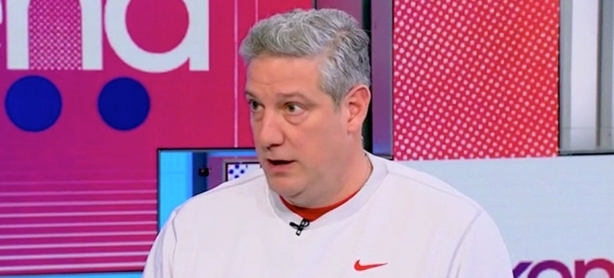
During an interview on Saturday, former Democratic lawmaker Tim Ryan made a bold statement regarding the current state of the Democratic Party, suggesting that it was in desperate need of a comprehensive rebranding. Ryan argued that many aspects of the party’s identity had become “toxic,” implying that the party’s image and its connection with voters had been significantly damaged. His comments reflect a broader concern about the effectiveness and appeal of the Democratic Party, especially in the wake of challenging election results and shifting public perceptions.
Ryan, who represented Ohio in Congress for nearly two decades, emphasized that the party had to undergo a transformation if it hoped to regain the trust of American voters. He pointed to the growing divide between the establishment wing of the party and the progressive factions that have gained prominence in recent years. According to Ryan, the way the Democratic Party is currently perceived by many voters—particularly in more conservative or swing states—needs to be reassessed and adjusted to better reflect the concerns of the electorate.
The term “toxic,” as used by Ryan, was particularly striking. He suggested that certain elements of the party’s current brand—whether it be its policies, its messaging, or its leadership—had alienated key segments of the voting population. For instance, Ryan highlighted that many working-class Americans, particularly those in the Midwest, had become disillusioned with the Democratic Party. These voters, who had traditionally supported the party in past decades, have increasingly turned to the Republican Party in recent elections, driven in part by dissatisfaction with issues like economic inequality, job loss, and cultural divides.
Ryan’s call for a rebranding of the Democratic Party is not entirely new. Over the past several years, there has been a growing debate within the party about its future direction. Some have called for a return to centrist policies that appeal to a broader swath of the American population, while others argue for a more progressive approach that prioritizes bold action on issues like climate change, healthcare reform, and income inequality. Ryan himself, having been a part of the centrist wing of the party during his time in Congress, appears to advocate for a middle-ground approach—one that would emphasize pragmatism and an understanding of the issues that matter most to working-class Americans.
In his interview, Ryan also discussed the challenges the Democratic Party faces in terms of messaging. He noted that the party has struggled to communicate its vision effectively to voters outside of major urban centers, where Democrats have a stronghold. In smaller towns and rural areas, the party’s message often falls flat, as voters feel disconnected from the policies and priorities of party leaders. Ryan suggested that the Democratic Party needed to better articulate a vision that resonated with these voters, showing them that the party was committed to addressing their concerns, rather than focusing primarily on issues that may seem irrelevant to them.
The conversation about the future of the Democratic Party has only intensified as the 2024 presidential election approaches. With both the Republican and Democratic parties facing internal divisions, there is a growing sense that the next election will be a referendum on the direction of the nation. Ryan’s comments underscore the urgency of this moment, as the Democratic Party must find a way to balance its ideological factions, adapt its messaging, and re-establish its connection with voters who have drifted away in recent years.
Ultimately, Ryan’s call for a rebrand reflects his deep concern about the Democratic Party’s ability to effectively compete in future elections. He believes that without a shift in strategy and a more inclusive approach to policy and messaging, the party risks further alienating the very voters it needs to win over in order to maintain political relevance. Whether or not the party will heed Ryan’s advice remains to be seen, but his remarks serve as a stark reminder of the challenges the Democratic Party faces in an increasingly polarized political environment.
“Tim Ryan Calls for Complete Rebrand of the Democratic Party to Overcome ‘Toxic’ Image”


Recent Comments
on Hello world!