

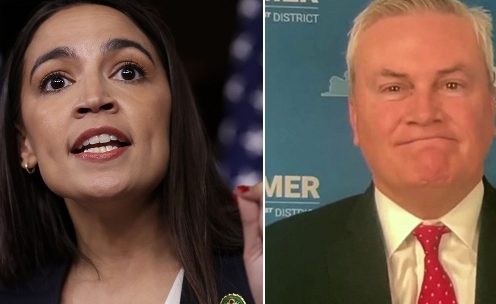
Rep. James Comer, a Republican from Kentucky, who serves as the Chairman of the House Oversight Committee, has thrown his support behind Rep. Alexandria Ocasio-Cortez, a Democratic congresswoman from New York, in her attempt to secure the ranking member position on the committee. Ocasio-Cortez is looking to challenge fellow Democrat Rep. Jamie Raskin for this prominent role, which has sparked considerable attention and debate within the political sphere.
The endorsement from Comer is notable, as it highlights an unusual moment of cross-party collaboration. While Comer is a member of the Republican Party and Ocasio-Cortez is from the Democratic Party, the political dynamics of the House Oversight Committee have prompted this unusual alignment. Ocasio-Cortez’s move to challenge Raskin for the ranking member spot has already attracted significant attention, as it represents a shift in leadership within the Democratic Party.
In the context of this challenge, Ocasio-Cortez’s bid is seen as a reflection of her growing influence within the Democratic Party, as she continues to assert herself as a leader among her colleagues. Meanwhile, Raskin, who has held the position, is a respected figure within the party, and his potential loss of the ranking member title would signal a shift in the internal politics of the Democratic caucus.
Comer’s support of Ocasio-Cortez may be driven by a number of factors. As Chairman of the Oversight Committee, Comer has an interest in shaping the committee’s leadership in ways that could benefit his own agenda and the broader GOP. His backing of Ocasio-Cortez could be seen as a strategic move to foster political alliances, even across party lines, that could prove advantageous in the future. By supporting a high-profile Democratic member like Ocasio-Cortez, Comer could be attempting to navigate a delicate political landscape and influence the trajectory of the committee.
This endorsement also brings attention to the ongoing dynamics between the two major political parties, with figures from opposite sides of the aisle coming together in support of a common cause. While such support is rare, it underscores the complex nature of politics in the modern era, where alliances and allegiances are not always confined strictly to party lines. In this instance, Comer’s support for Ocasio-Cortez may highlight a broader strategy to engage with influential members of the opposing party, especially when it comes to committee leadership, which plays a critical role in shaping legislative priorities.
Ocasio-Cortez’s challenge to Raskin also comes at a time when the Democratic Party is navigating internal divisions and discussions about its direction and leadership. As one of the most prominent progressive voices in Congress, Ocasio-Cortez’s rise within the party has been marked by her advocacy for bold policy positions, such as the Green New Deal and universal healthcare. Her potential to take on a leadership role within the Oversight Committee could further solidify her standing as a key player in shaping the future of the Democratic Party.
Raskin, meanwhile, has been a key figure in the party, known for his role in the impeachment proceedings against former President Donald Trump and for his staunch defense of democratic values. His position as ranking member has been a source of influence, but his potential challenge from Ocasio-Cortez signals a new chapter in the dynamics of the House Oversight Committee.
In conclusion, the race for the ranking member position on the House Oversight Committee has become a focal point of political maneuvering, with Rep. James Comer’s support for Rep. Alexandria Ocasio-Cortez drawing attention to the growing complexity of inter-party relationships in Congress. As Ocasio-Cortez seeks to take on a more prominent leadership role, the implications of this challenge will be felt within both the Democratic and Republican parties, shaping the future of the committee and its impact on legislative priorities.
“Rep. James Comer Supports Alexandria Ocasio-Cortez’s Bid for Ranking Member of House Oversight Committee”


Recent Comments
on Hello world!